


Equivalent-circuit picture of D-CTCs#
Description#
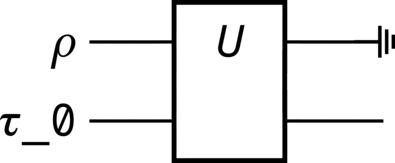
This algorithm implements the equivalent-circuit picture (ECP, see sec:ECP Iterative picture: The equivalent circuit) of D-CTCs. In its current form, it is not a particularly useful example, having very general input state and unitary matrix symbolic representations that make any subsequent analysis infeasible. Instead, the algorithm is included simply because it is an interesting demonstration of advanced usage of Qhronology. Note that the larger the number of algebraic symbols (and associated substitutions) that are contained within the states and gates, the higher the complexity of the internal calculations, resulting in correspondingly longer computation times.


Implementation#
The desired number of iterations can be changed by setting iterations to an appropriate positive integer.
from qhronology.quantum.states import MixedState
from qhronology.quantum.gates import QuantumGate
from qhronology.quantum.circuits import QuantumCircuit
from qhronology.mechanics.operations import dagger

import sympy as sp

iterations = 1
dimensionality = 2

# Input
rho = sp.MatrixSymbol("ρ", dimensionality, dimensionality).as_mutable()
respecting_state = MixedState(
    spec=rho,
    dim=dimensionality,
    substitutions=[(sp.trace(rho), 1)],
    label="ρ",
)
seed_state = MixedState(
    spec=sp.eye(dimensionality),
    dim=dimensionality,
    norm=1,
    label="τ_0",
)

# Gate
unitary = sp.MatrixSymbol(
    "U",
    dimensionality**2,
    dimensionality**2,
).as_mutable()
U = QuantumGate(
    spec=unitary,
    targets=[0, 1],
    num_systems=2,
    dim=dimensionality,
)

# Construct substitutions
substitutions_CR = [(sp.trace(rho), 1)]
substitutions_unitary = [
    ((unitary * dagger(unitary))[n], (sp.eye(dimensionality**2))[n])
    for n in range(0, len(unitary))
]
substitutions = substitutions_CR + substitutions_unitary

# Circuit
violating_state = seed_state
for n in range(1, iterations + 1):
    iteration = QuantumCircuit(
        inputs=[respecting_state, violating_state],
        gates=[U],
        substitutions=substitutions,
        traces=[0],
    )
    iteration.diagram(pad=(1, 0), sep=(0, 1), style="unicode")
    violating_state = iteration.state(label=f"τ_{n}")
    violating_state.simplify()

# Output
final_state = violating_state

# Results
seed_state.print()
# final_state.print()  # Too large to display
Output#
Diagram#
>>> iteration.diagram(pad=(1, 0), sep=(0, 1), style="unicode")

States#
>>> seed_state.print()
τ_0 = 1/2|0⟩⟨0| + 1/2|1⟩⟨1|
Of course, this example uses general (symbolic) forms for the input state \(\StateCR\) and interaction \(\Unitary\). To investigate the ECP in the context of specific time-travel scenarios, explicit forms for both \(\StateCR\) and \(\Unitary\) can be set.