


Prescriptions#
In Qhronology, quantum circuit models of closed timelike curves (CTCs) are created as instances of the QuantumCTC class:
from qhronology.quantum.prescriptions import QuantumCTC
This provides almost identical functionality as the QuantumCircuit class (from which it is derived), differing only in the addition of the systems_respecting and systems_violating properties.
Built upon the QuantumCTC class are the various theoretical models (prescriptions) of quantum time travel. Qhronology currently implements two such prescriptions: Deutsch’s model (D-CTCs) and postselected teleportation (P-CTCs):
from qhronology.quantum.prescriptions import DCTC, PCTC
Due to their close relationship, instances of the QuantumCTC class can be created directly from instances of the QuantumCircuit class. This is achieved by way of the circuit argument in the QuantumCTC constructor, whereby all attributes of the given QuantumCircuit instance are copied (deeply) to the QuantumCTC instance during initialization. Importantly, this enables the various subclasses, such as DCTC and PCTC, to be instantiated entirely using a single QuantumCTC instance, thereby reducing duplication (of arguments) in cases where one wishes to study multiple prescriptions of the same CTC circuit.
Main class#
Please note that the documentation of this class includes only properties and methods that are either new or modified from its base class QuantumCircuit.
- class QuantumCTC(
- *args,
- systems_violating: list[int],
- circuit: QuantumCircuit | None = None,
- **kwargs,
Bases:
QuantumCircuitA class for creating quantum circuit models of quantum interactions near closed timelike curves and storing their metadata.
This is built upon the
QuantumCircuitclass, and so inherits all of its attributes, properties, and methods.Instances provide complete descriptions of quantum circuits involving antichronological time travel. The class however does not possess any ability to compute the output state (e.g., resolve temporal paradoxes) of the circuit; that functionality is associated with the specific prescriptions of quantum time travel, which are implemented as subclasses.
- Parameters:
*args – Variable length argument list, passed directly to the constructor
__init__of the superclassQuantumCircuit.circuit (
QuantumCircuit) – An instance of theQuantumCircuitclass. The values of its attributes override any other values specified in*argsand**kwargs. Defaults toNone.systems_violating (
list[int]) – The numerical indices of the chronology-violating (CV) subsystems. Defaults to[].**kwargs – Arbitrary keyword arguments, passed directly to the constructor
__init__of the superclassQuantumCircuit.
Note
The
circuitargument can be used to merge the value of every attribute from a pre-existingQuantumCircuitinstance into theQuantumCTCinstance. Any such merges override the values of the attributes associated with the other arguments specified in the constructor. It is therefore best practice to specify the circuit via either of the following two ways:the
circuitargument*argsand**kwargslike a typical initialization of aQuantumCircuitinstance (without usingcircuit)
Note that this is in addition to providing a value to the
systems_violatingargument.Note
All systems not corresponding to indices specified in
systems_violatingare assumed to be chronology-respecting (CR) and appear in thesystems_respectingclass property.Note
The total interaction between the CR and CV systems is expected to be unitary, and so the sequence of gates in
gatescannot contain any non-unitary gates (e.g., measurement operations).Note
Post-processing (e.g., traces and postselections) cannot be performed on any chronology-violating (CV) systems (i.e., those corresponding to indices specified in
systems_violating).
Examples
from qhronology.quantum.states import MixedState
from qhronology.quantum.gates import Swap, Pauli
from qhronology.quantum.prescriptions import QuantumCTC, DCTC, PCTC

import sympy as sp

# Input
rho = sp.MatrixSymbol("ρ", 2, 2).as_mutable()
input_state = MixedState(
    spec=rho,
    substitutions=[(rho[0, 0] + rho[1, 1], 1)],  # For normalization
    label="ρ",
    norm=1,
)

# Gate
S = Swap(targets=[0, 1], num_systems=2)
I = Pauli(index=0, targets=[0, 1], num_systems=2)

# CTC
SWAP_CTC = QuantumCTC(
    inputs=[input_state],
    gates=[S],
    systems_violating=[1],
)
SWAP_CTC.diagram()

# Output
# D-CTCs
SWAP_DCTC = DCTC(circuit=SWAP_CTC)
SWAP_DCTC_CR = SWAP_DCTC.state_respecting(label="ρ_D")
SWAP_DCTC_CV = SWAP_DCTC.state_violating(label="τ_D")

# P-CTCs
SWAP_PCTC = PCTC(circuit=SWAP_CTC)
SWAP_PCTC_CR = SWAP_PCTC.state_respecting(label="ρ_P")
SWAP_PCTC_CV = SWAP_PCTC.state_violating(label="τ_P")

# Results
SWAP_DCTC_CR.print(simplification=True)
SWAP_DCTC_CV.print(simplification=True)
SWAP_PCTC_CR.print(simplification=True)
SWAP_PCTC_CV.print(simplification=True)
>>> SWAP_CTC.diagram()

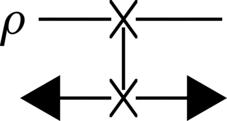
>>> SWAP_DCTC_CR.print(simplification=True)
ρ_D = ρ[0, 0]|0⟩⟨0| + ρ[0, 1]|0⟩⟨1| + ρ[1, 0]|1⟩⟨0| + ρ[1, 1]|1⟩⟨1|
>>> SWAP_DCTC_CV.print(simplification=True)
τ_D = ρ[0, 0]|0⟩⟨0| + ρ[0, 1]|0⟩⟨1| + ρ[1, 0]|1⟩⟨0| + ρ[1, 1]|1⟩⟨1|
>>> SWAP_PCTC_CR.print(simplification=True)
ρ_P = ρ[0, 0]|0⟩⟨0| + ρ[0, 1]|0⟩⟨1| + ρ[1, 0]|1⟩⟨0| + ρ[1, 1]|1⟩⟨1|
>>> SWAP_PCTC_CV.print(simplification=True)
τ_P = ρ[0, 0]|0⟩⟨0| + ρ[0, 1]|0⟩⟨1| + ρ[1, 0]|1⟩⟨0| + ρ[1, 1]|1⟩⟨1|
from qhronology.quantum.states import MixedState
from qhronology.quantum.gates import Not
from qhronology.quantum.circuits import QuantumCircuit
from qhronology.quantum.prescriptions import QuantumCTC, DCTC, PCTC

import sympy as sp

# Input
rho = sp.MatrixSymbol("ρ", 2, 2).as_mutable()
input_state = MixedState(
    spec=rho,
    substitutions=[(rho[0, 0] + rho[1, 1], 1)],  # For normalization
    label="ρ",
    norm=1,
)
input_state.simplify()

# Gate
CN = Not(targets=[0], controls=[1], num_systems=2)

# CTC
CNOT = QuantumCircuit(
    inputs=[input_state],
    gates=[CN],
)
CNOT_CTC = QuantumCTC(circuit=CNOT, systems_violating=[0])
CNOT_CTC.diagram()

# Output
# D-CTCs
CNOT_DCTC = DCTC(circuit=CNOT_CTC)
CNOT_DCTC_CR = CNOT_DCTC.state_respecting(label="ρ_D")
CNOT_DCTC_CV = CNOT_DCTC.state_violating(label="τ_D")

# P-CTCs
CNOT_PCTC = PCTC(circuit=CNOT_CTC)
CNOT_PCTC_CR = CNOT_PCTC.state_respecting(norm=1, label="ρ_P")
CNOT_PCTC_CV = CNOT_PCTC.state_violating(label="τ_P")

# Results
CNOT_DCTC_CR.print(simplification=True)
CNOT_DCTC_CV.print(simplification=True)
CNOT_PCTC_CR.print(simplification=True)
CNOT_PCTC_CV.print(simplification=True)
>>> CNOT_CTC.diagram()

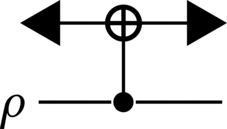
>>> CNOT_DCTC_CR.print(simplification=True)
ρ_D = ρ[0, 0]|0⟩⟨0| + 2*g*ρ[0, 1]|0⟩⟨1| + 2*g*ρ[1, 0]|1⟩⟨0| + ρ[1, 1]|1⟩⟨1|
>>> CNOT_DCTC_CV.print(simplification=True)
τ_D = 1/2|0⟩⟨0| + g|0⟩⟨1| + g|1⟩⟨0| + 1/2|1⟩⟨1|
>>> CNOT_PCTC_CR.print(simplification=True)
ρ_P = |0⟩⟨0|
>>> CNOT_PCTC_CV.print(simplification=True)
τ_P = 1/2|0⟩⟨0| + 1/2|1⟩⟨1|
Constructor argument properties#
- property QuantumCTC.systems_respecting: list[int]#
The numerical indices of the chronology-respecting (CR) subsystems.
- property QuantumCTC.systems_violating: list[int]#
The numerical indices of the chronology-violating (CV) subsystems.
Methods#
- QuantumCTC.input(
- merge: bool | None = None,
- numerical: bool | None = None,
- array: bool | None = None,
- substitutions: list[tuple[num | expr | str, num | expr | str]] | None = None,
- simplification: bool | None = None,
- conjugation: bool | None = None,
- norm: bool | num | expr | str | None = None,
- label: str | None = None,
- notation: str | None = None,
- debug: bool | None = None,
Construct the composite chronology-respecting (CR) input state of the closed timelike curve as a
QuantumStateinstance.This is computed as the tensor product of the individual gates in the order in which they appear in the
inputsproperty.Is a vector state only when all of the component states are vectors.
- Parameters:
merge (
bool) – Whether to merge the labels of the individual quantum states into a single product, separated by"⊗"operators, prior to any notational processing. Only relevant when all states are vectors. Defaults toTrue.numerical (
bool) – Whether to cast the state’s matrix elements as floating-point values (True) (if possible) or exact values (False). Defaults to the value ofself.numerical.array (
bool) – Whether to cast the state’s matrix as a NumPy array (True) or SymPy matrix (False). Defaults to the value ofself.array.substitutions (
list[tuple[num | expr | str,num | expr | str]]) – Algebraic substitutions to be applied to the state. Defaults to the value ofself.substitutions.simplification (
bool) – Whether to perform mathematical simplification on the state. IfFalse, does not simplify. Defaults to the value ofself.simplification.conjugation (
bool) – Whether to perform Hermitian conjugation on the state. IfFalse, does not conjugate. Defaults toFalse.norm (
bool | num | expr | str) – The value to which the state is normalized. IfTrue, normalizes to a value of \(1\). IfFalse, does not normalize. Defaults toFalse.label (
str) – The unformatted string used to represent the state in mathematical expressions. Must have a non-zero length. Defaults to"⊗".join([state.label for state in self.inputs]).notation (
str) – The formatted string used to represent the state in mathematical expressions. When notNone, overrides the value passed tolabel. Must have a non-zero length. Not intended to be set by the user in most cases. Defaults to"⊗".join([state.notation for state in self.inputs])iflabelisNoneand eithermergeisFalseor the input states are all vectors, elseNone.debug (
bool) – Whether to print the internal state (held inmatrix) on change. IfFalse, does not print. Defaults toFalse.
- Returns:
QuantumState– The circuit’s total input state as aQuantumStateinstance.
Note
Passing a value of
Falseto themergeargument results in a state whosenotationis fixed and incompatible with any subsequent changes (including densification). This behaviour may be improved in the future.
- QuantumCTC.diagram(
- pad: tuple[int, int] | None = None,
- sep: tuple[int, int] | None = None,
- uniform_spacing: bool | None = None,
- force_separation: bool | None = None,
- style: str | None = None,
- visible: set[str] | None = None,
- return_string: bool | None = None,
Print or return a diagram of the quantum circuit as a multiline string.
- Parameters:
pad (
tuple[int,int]) – A 2-tuple of non-negative integers specifying intra-gate padding (i.e., the horizontal and vertical interior paddings between the content at the centre of each gate (e.g., label) and its outer edge (e.g., block border). Defaults to(0, 0).sep (
tuple[int,int]) – A 2-tuple of non-negative integers specifying inter-gate separation (i.e., the horizontal and vertical exterior separation distances between the edges of neighbouring gates. Defaults to(1, 1).uniform_spacing (
bool) – Whether to uniformly space the gates horizontally such that the midpoint of each is equidistant from those of its neighbours. Defaults toFalse.force_separation (
bool) – Whether to force the horizontal gate separation to be exactly the value given insepfor all gates in the circuit. When notFalse, the value ofuniform_spacingis ignored. Defaults toFalse.style (
str) – A string specifying the style for the circuit visualization to take. Can be any of"ascii","unicode", or"unicode_alt". Defaults to"unicode".visible (
set[str]) – A set of strings specifying which components of the circuit to include in the visualization. Can contain any of"inputs","gates", or"outputs". Defaults to{"inputs", "gates", "outputs"}.return_string (
bool) – Whether to return the assembled diagram as a multiline string. Defaults toFalse.
- Returns:
None– Returned ifreturn_stringisFalse.str– The rendered circuit diagram. Returned ifreturn_stringisTrue.
Note
The quality of the semigraphical diagrams depends greatly on the typeface with which they are visualized. For best results, monospace (fixed-width) fonts with good Unicode coverage should be used.
Examples
Please see the examples of the
QuantumCTCclass itself. For advanced usage examples, see the correspondingdiagram()method of theQuantumCircuitclass.
Subclasses#
Please note that the documentation of these subclasses includes only properties and methods that are either new or modified from the base class QuantumCTC.